
What Is a Standard Doji?
A Standard Doji is a single candlestick pattern where the open and close prices are nearly equal, forming a small body with upper and lower shadows.
This pattern represents market indecision — a moment when buyers and sellers are in balance.
However, not all Doji signals lead to reversals. The key is where the Doji forms.
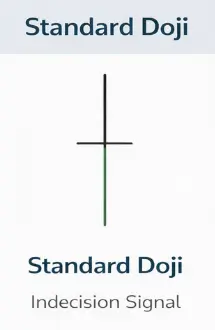
Key Characteristics of a Standard Doji
- Very small or nearly invisible body
- Upper and lower wicks present
- Open ≈ Close
- Appears during trending or ranging markets
What Does a Standard Doji Mean?
A Standard Doji shows that:
- Buyers tried to push price higher
- Sellers pushed it back down
- The market closes near the starting point
This reflects indecision and loss of momentum
A Standard Doji shows that:
- Buyers tried to push price higher
- Sellers pushed it back down
- The market closes near the starting point
This reflects indecision and loss of momentum
But remember:
A Doji is not a signal by itself — it becomes meaningful only at key levels.
When Is a Standard Doji Useful?
A Doji becomes powerful when it appears at:
Support Level (Bullish Potential)
- Sellers push price down
- Buyers reject lower prices
- Doji forms → indecision
- Next candle turns bullish
This may signal a bullish reversal
Resistance Level (Bearish Potential)
- Buyers push price up
- Sellers reject higher prices
- Doji forms → indecision
But without confirmation, this is not a strong sell signal
How to Trade the Standard Doji (Step-by-Step Guide)
Step 1: Identify Key Levels
Look for:
- Support and resistance zones
- Previous swing highs/lows
- Supply and demand areas
Step 2: Wait for the Doji to Form
Do NOT enter immediately.
Wait for the market to show indecision through a Doji candle.
Step 3: Wait for Confirmation
Enter only when:
- The next candle closes bullish (for buys)
OR - Price breaks above the Doji high
Entry, Stop Loss, Take Profit
Entry:
- Break above the Doji high
Stop Loss:
- Below the Doji low
Take Profit:
- Next resistance level
- Or use a minimum Risk ratio of 1:2
Common Mistakes to Avoid
❌ Trading Doji in the middle of nowhere
❌ Entering without confirmation
❌ Ignoring market structure
❌ Treating Doji as a guaranteed reversal
Standard Doji vs Other Doji Types
- Standard Doji → Balanced indecision
- Gravestone Doji → Bearish rejection (at resistance)
- Dragonfly Doji → Bullish rejection (at support)
- Long-Legged Doji → High volatility + indecision
Key Insight
Don’t trade the pattern. Trade the context behind it.
Explore More Candlestick Strategies
- Bullish → Hammer & Inverted Hammer Strategy
- Bearish → Shooting Star & Hanging Man Strategy
Final Thoughts
The Standard Doji is a powerful tool — but only when used correctly.
Always focus on:
- Market structure
- Key levels
- Confirmation
When combined properly, the Doji can help you identify high-probability reversal opportunities.
Explore Doji Candlestick Types
- Standard Doji – Basic indecision pattern
- Gravestone Doji – Bearish reversal at resistance
- Dragonfly Doji – Bullish reversal at support
- Long-Legged Doji – High volatility and indecision
Learn all Doji candlestick types → Doji Candlestick Types Guide
About the Author
David William – Professional Forex & Crypto Trader
More trading insights at trading-strategy-hub.com
Disclaimer: This content is for educational purposes only and does not constitute financial advice.