
What is a Bearish Fair Value Gap (FVG)?
A Bearish Fair Value Gap (FVG) is a price imbalance that occurs when the market moves aggressively downward, leaving behind a gap where little to no trading activity has taken place.
This concept is widely used in price action trading and smart money strategies, as it highlights areas where the market may return to “rebalance” inefficient price movement.
In simple terms:
A Bearish FVG represents an area where price dropped too fast, creating an imbalance that often attracts price back before continuing downward.
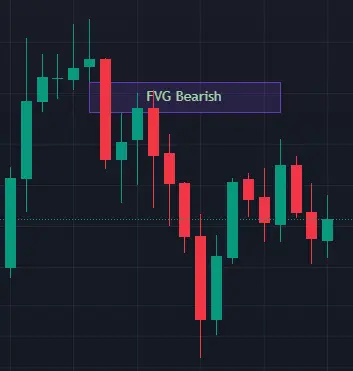
How to Identify a Bearish FVG (3-Candle Pattern)
A bearish FVG is formed using a three-candle structure:
- The first candle (bullish or neutral)
- The second candle (strong bearish move)
- The third candle continues lower
Key Condition:
The high of the third candle is lower than the low of the first candle
This creates a gap between candle 1 and candle 3, known as the Fair Value Gap.
Why Does Bearish FVG Work?
Financial markets seek efficiency. When price moves too quickly, it creates inefficient pricing zones.
These zones tend to:
- Attract price back for rebalancing
- Act as supply zones (resistance)
- Provide high-probability short entries
This is why many traders use FVG as part of a smart money trading strategy.
How to Trade Bearish FVG (Step-by-Step)
Step 1: Identify a Downtrend
Always trade FVG with the trend. A bearish FVG works best in a clear downtrend.
Step 2: Mark the FVG Zone
Draw the gap between:
- Candle 1 low
- Candle 3 high
This becomes your sell zone.
Step 3: Wait for Price to Retrace
Do NOT enter immediately.
Instead:
Wait for price to return (retrace) into the FVG zone
Step 4: Look for Confirmation
Before entering a short trade, look for:
- Rejection candles
- Lower highs
- Weak bullish momentum
Step 5: Execute the Trade
- Entry: Inside the FVG zone
- Stop loss: Above the FVG
- Take profit: Previous low or structure support
Bearish FVG vs Resistance: What’s the Difference?
While both act as resistance, a Bearish FVG is more specific:
| Feature | Bearish FVG | Traditional Resistance |
|---|---|---|
| Based on | Price imbalance | Historical price |
| Precision | High | Medium |
| Entry timing | Retracement-based | Reaction-based |
FVG provides a more precise entry zone
Common Mistakes Traders Make
❌ Entering Too Early
Many traders short immediately after spotting an FVG.
Correct approach:
Wait for price to return into the gap
❌ Ignoring Market Structure
FVG alone is not enough.
Combine with:
- Trend direction
- Support/resistance
- Volume profile
❌ Trading Inside Consolidation
FVG works best in trending markets, not sideways ranges.
Pro Tips for Using Bearish FVG
- Combine with Fibonacci (0.618–0.666 zone)
- Use with Volume Profile (POC / VAH)
- Focus on higher timeframes (1H, 4H, Daily)
- Look for confluence zones
Final Thoughts
A Bearish Fair Value Gap (FVG) is a powerful concept used by professional traders to identify high-probability short setups.
When used correctly, it helps you:
- Enter trades with precision
- Avoid chasing price
- Align with institutional order flow
The key is patience: wait for price to return to the imbalance before taking action.
To fully understand market dynamics, it’s important to study both bullish and bearish setups.
You can explore long opportunities in our complete guide on
Bullish Fair Value Gap (FVG) trading strategy
About the Author
David William – Professional Forex & Crypto Trader
More trading insights at trading-strategy-hub.com
Disclaimer: This analysis is for educational purposes only and does not constitute financial advice.