
What Is a Long-Legged Doji?
A Long-Legged Doji is a candlestick pattern where the open and close prices are nearly equal, but with long upper and lower shadows.
This pattern reflects extreme indecision and high volatility, as both buyers and sellers aggressively push price in both directions before closing near the same level.
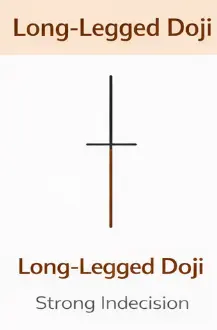
Key Characteristics of a Long-Legged Doji
- Very small or no real body (Open ≈ Close)
- Long upper shadow
- Long lower shadow
- Appears during strong trends or after large price movements
What Does a Long-Legged Doji Mean?
A Long-Legged Doji shows that:
- Buyers pushed price significantly higher
- Sellers pushed price significantly lower
- Neither side gained control
This represents strong market indecision and potential trend exhaustion
However:
A Long-Legged Doji is not a signal by itself — context is everything.
When Is a Long-Legged Doji Powerful?
The pattern becomes meaningful when it forms at key levels.
At Support (Bullish Potential)
- Sellers push price down aggressively
- Buyers step in and reject lower levels
- Price returns to the open
This may indicate accumulation and a possible bullish reversal
At Resistance (Bearish Potential)
- Buyers push price higher
- Sellers reject higher prices strongly
- Price closes near the open
This may signal distribution and a potential bearish reversal
Long-Legged Doji vs Standard Doji
- Standard Doji → Balanced indecision (low volatility)
- Long-Legged Doji → Extreme indecision (high volatility)
The longer the shadows, the stronger the battle between buyers and sellers.
How to Trade the Long-Legged Doji (Step-by-Step Guide)
Step 1: Identify Key Levels
Focus on:
- Strong support and resistance zones
- Major swing highs and lows
- Supply and demand areas
Step 2: Wait for the Pattern
Do NOT enter immediately.
Let the Long-Legged Doji form to confirm indecision.
Step 3: Wait for Confirmation
Enter only when:
- Price breaks above the high (for bullish setups)
OR - Price breaks below the low (for bearish setups)
Entry, Stop Loss, Take Profit
Entry:
- Breakout of the Doji high/low
Stop Loss:
- Opposite side of the Doji
Take Profit:
- Next key level
- Minimum Risk ratio of 1:2
Common Mistakes to Avoid
❌ Trading Doji without key levels
❌ Ignoring volatility context
❌ Entering before confirmation
❌ Overtrading in choppy markets
Key Insight
Volatility without direction is a warning — wait for confirmation before entering.
Explore More Candlestick Strategies
- Bullish → Hammer & Inverted Hammer Strategy
- Bearish → Shooting Star & Hanging Man Strategy
- Learn all Doji types → Doji Candlestick Types Guide
Final Thoughts
The Long-Legged Doji is a powerful signal of market indecision and volatility.
But like all candlestick patterns, it must be used with:
- Proper context
- Key levels
- Confirmation
When combined correctly, it can help you identify high-probability breakout or reversal opportunities.
Explore Doji Candlestick Types
- Standard Doji – Basic indecision pattern
- Gravestone Doji – Bearish reversal at resistance
- Dragonfly Doji – Bullish reversal at support
- Long-Legged Doji – High volatility and indecision
Learn all Doji candlestick types → Doji Candlestick Types Guide
About the Author
David William – Professional Forex & Crypto Trader
More trading insights at trading-strategy-hub.com
Disclaimer: This content is for educational purposes only and does not constitute financial advice.